?AskGuidesCallsCalc#Codes

Built for techs who diagnose, not guess

Real HVAC answers.
Right when you need them.

Field-tested troubleshooting, clear explanations, and an AI sidekick that speaks technician—not textbook.

ASK GAUGE FREE DEMO MODE
AI preview—no credits required.Try the troubleshooting flow while live AI is paused.
Try:
FIELD DIAGNOSTICReady to help.Systems online
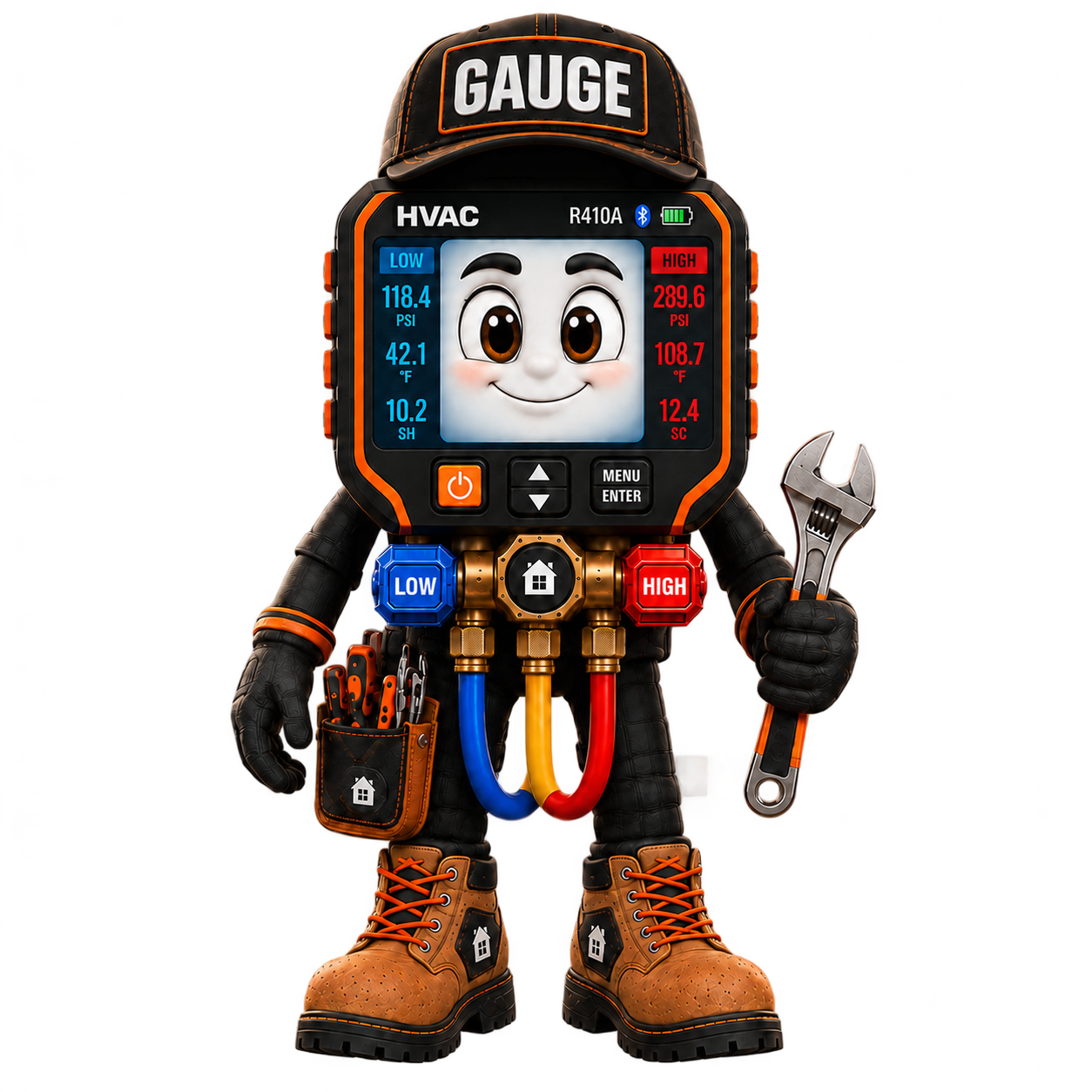
Gauge, a friendly digital HVAC manifold mascot wearing a Gauge hat
GAUGETHE HVAC ANSWER GUY SIDEKICK

DIAGNOSE. FIX. LEARN. REPEAT.

Real answers. No bullshit.For working HVAC professionals

START WITH THE SYMPTOM

Get unstuck faster.

Practical answers organized around the problems you actually see in the field.

FIELD GUIDE LIBRARY

Find the job. Open one guide.

Troubleshooting, installation and maintenance procedures live together here without cluttering the main navigation.

FREE FIELD TOOLS

Guided diagnostics.

Choose the call, work the checks in order, and collect the measurements that actually narrow the problem.

Gas heat

No heat—gas furnace

Follow the ignition sequence
  1. Record the board code before cycling power.
  2. Verify inducer, venting, condensate and pressure-switch response.
  3. Observe ignitor, gas valve, burner carryover and flame signal.
  4. Check limits, rollout circuit, airflow and temperature rise.
FIELD RULE

Record the original fault before resetting power. Never bypass a safety or work live unless the manufacturer procedure requires it and you are trained and equipped to do so.

SERVICE CALL WORKBENCH

Keep the call organized.

Capture the equipment and readings once. Save the call on this device or load the details directly into Ask Gauge.

CONNECTED FIELD WORKFLOW

Commission, document, verify.

0%0 of 8 complete

Progress remains on this device and works offline.

COMMISSIONING REQUIRES MODEL DATA

This checklist organizes the work; the exact manufacturer procedure, approved instruments, licensing, adopted code and job-specific design always control.

FREE FIELD CALCULATORS

Do the math. Keep diagnosing.

Fast worksheets for common field calculations. Results organize measurements—they do not replace model-specific targets or procedures.

ACTIVE WORKSHEET

Temperature split

Return minus supply in cooling

CALCULATED RESULT20.0°F temperature split
VERIFY BEFORE ACTION

Temperature split is a screening measurement, not a universal pass/fail target. Compare entering-air conditions, airflow, latent load, and the exact manufacturer data.

MANUFACTURER-SPECIFIC

Error-code lookup.

Choose the equipment type first, then the manufacturer group and exact family. Refrigerant and generation stay with the model—not in a separate section.

Verified entries are shown by default
Showing 20 of 147 matching source-verified entries
LennoxE201
Communicating gas furnace controls

Indoor blower communication failure

Verify blower power and communication wiring, then confirm the motor and control configuration.

✓ SOURCE VERIFIEDManufacturer source ↗
LennoxE207
Communicating gas furnace controls

Hot-surface ignitor sensed open

Measure ignitor resistance and compare it with the unit specification; inspect the harness and connections.

✓ SOURCE VERIFIEDManufacturer source ↗
LennoxE223
Communicating gas furnace controls

Low pressure switch failed open

Measure inducer pressure, inspect venting and combustion air for restriction, and verify pressure-switch operation.

✓ SOURCE VERIFIEDManufacturer source ↗
LennoxE240
Communicating gas furnace controls

Low flame current in run mode

Measure flame-sensor microamps, inspect or clean the sensor, and verify grounding and neutral-to-ground voltage.

✓ SOURCE VERIFIEDManufacturer source ↗
LennoxE250
Communicating gas furnace controls

Limit switch circuit open

Find the cause of the limit trip; check airflow, temperature rise, firing rate, filter, coil, and blower performance.

✓ SOURCE VERIFIEDManufacturer source ↗
Daikin / Goodman / AmanaU0
Daikin 17 Series R-410A wall-mount — FTX/FTK(X)B with RK(X)B/RK(X)N

Insufficient refrigerant

Inspect for leaks and verify charge using the model-specific procedure; do not add refrigerant from the code alone.

✓ SOURCE VERIFIEDManufacturer source ↗
Daikin / Goodman / AmanaU2
Daikin 17 Series R-410A wall-mount — FTX/FTK(X)B with RK(X)B/RK(X)N

DC voltage out of range

Verify incoming power, connections, and inverter DC-bus conditions using the service-manual flowchart.

✓ SOURCE VERIFIEDManufacturer source ↗
Daikin / Goodman / AmanaU4
Daikin 17 Series R-410A wall-mount — FTX/FTK(X)B with RK(X)B/RK(X)N

Indoor–outdoor communication abnormality

Check interconnect wiring, terminals, continuity, power, and boards using the model-family procedure.

✓ SOURCE VERIFIEDManufacturer source ↗
Daikin / Goodman / AmanaA6
Daikin 17 Series R-410A wall-mount — FTX/FTK(X)B with RK(X)B/RK(X)N

Indoor fan motor abnormality

Inspect the fan for obstruction, wiring and connectors, motor feedback, and indoor PCB output per the service flowchart.

✓ SOURCE VERIFIEDManufacturer source ↗
Daikin / Goodman / AmanaH0
Daikin 17 Series R-410A wall-mount — FTX/FTK(X)B with RK(X)B/RK(X)N

Compressor sensor-system abnormality

Inspect compressor sensor circuits, wiring and connectors, then follow the service-manual sensor and outdoor-board checks.

✓ SOURCE VERIFIEDManufacturer source ↗
Daikin / Goodman / AmanaH6
Daikin 17 Series R-410A wall-mount — FTX/FTK(X)B with RK(X)B/RK(X)N

Compressor position-sensor abnormality

Verify compressor and inverter wiring, winding resistance and insulation, supply voltage, and the position-detection circuit.

✓ SOURCE VERIFIEDManufacturer source ↗
Daikin / Goodman / AmanaH8
Daikin 17 Series R-410A wall-mount — FTX/FTK(X)B with RK(X)B/RK(X)N

AC current-sensor abnormality

Check supply voltage and compressor current, inspect inverter connections, and follow the manual current-sensor diagnosis.

✓ SOURCE VERIFIEDManufacturer source ↗
Daikin / Goodman / AmanaH9
Daikin 17 Series R-410A wall-mount — FTX/FTK(X)B with RK(X)B/RK(X)N

Outdoor-air thermistor abnormality

Inspect the outdoor-air sensor placement, connector and harness, then compare resistance with the service temperature table.

✓ SOURCE VERIFIEDManufacturer source ↗
Daikin / Goodman / AmanaJ3
Daikin 17 Series R-410A wall-mount — FTX/FTK(X)B with RK(X)B/RK(X)N

Compressor discharge-pipe thermistor abnormality

Check sensor attachment, connector and harness, then compare thermistor resistance with actual discharge-pipe temperature.

✓ SOURCE VERIFIEDManufacturer source ↗
Daikin / Goodman / AmanaJ6
Daikin 17 Series R-410A wall-mount — FTX/FTK(X)B with RK(X)B/RK(X)N

Outdoor heat-exchanger thermistor abnormality

Inspect sensor location and contact, connector and wiring, then test resistance against measured coil temperature.

✓ SOURCE VERIFIEDManufacturer source ↗
Daikin / Goodman / AmanaL3
Daikin 17 Series R-410A wall-mount — FTX/FTK(X)B with RK(X)B/RK(X)N

Electrical-box temperature rise with compressor off

Inspect outdoor-board cooling, heat-sink condition, ambient exposure, wiring and power components using the manual flowchart.

✓ SOURCE VERIFIEDManufacturer source ↗
Daikin / Goodman / AmanaL4
Daikin 17 Series R-410A wall-mount — FTX/FTK(X)B with RK(X)B/RK(X)N

Heat-sink overheat with compressor on

Verify heat-sink cleanliness and contact, outdoor airflow, fan operation, inverter cooling and compressor load.

✓ SOURCE VERIFIEDManufacturer source ↗
Daikin / Goodman / AmanaL5
Daikin 17 Series R-410A wall-mount — FTX/FTK(X)B with RK(X)B/RK(X)N

IPM abnormality

Check incoming power, compressor wiring and resistance, heat-sink cooling, operating load, and inverter module per the service flowchart.

✓ SOURCE VERIFIEDManufacturer source ↗
Daikin / Goodman / AmanaP4
Daikin 17 Series R-410A wall-mount — FTX/FTK(X)B with RK(X)B/RK(X)N

Heat-sink thermistor abnormality

Inspect the heat-sink sensor, connector and harness, then compare resistance with the manual temperature table before condemning the board.

✓ SOURCE VERIFIEDManufacturer source ↗
MitsubishiP6
PAA multi-position air-handler systems

Freezing or overheating protection operation

Check filter and airflow restrictions, indoor and outdoor fan operation, operating conditions, charge, and refrigerant-circuit restrictions.

✓ SOURCE VERIFIEDManufacturer source ↗

Working library · 202 total entries across 12 manufacturer groups · 147 source-verified · 55 held out for source review. Codes are model-family specific; confirm the complete model number and current manufacturer literature before service.

MEMBERSHIP PREVIEW

Free tools. Serious upgrades.

This is proposed pricing for product planning—not an active checkout. The core field library stays useful without a subscription.

Preview onlyNo payments are being accepted and no plan can be purchased yet.

Free

$0/mo

Always useful
  • Verified error-code library
  • Guided diagnostic library
  • Device-local service calls
  • Printable service reports

Technician

$12/mo

Proposed monthly
  • Everything in Free
  • Ask Gauge live AI allowance
  • Follow-up diagnostic conversations
  • Saved AI job history

Company

Custom

Per-team pricing
  • Multiple technician seats
  • Shared company knowledge
  • Usage controls and reporting
  • Central billing and administration

Final pricing, question allowances, and company-seat terms will be set after field testing confirms real usage and operating cost.

FIELD TEST

Tell us what needs work.

Found something confusing, missing, or flat-out wrong? Send it straight to the team. Contact information is optional.

TRUST & SAFETY

Know what the tool does—and what it doesn’t.

Clear boundaries matter when technicians are working around live voltage, pressure, refrigerant, combustion, and rotating equipment.

PUBLIC FIELD TESTDEVICE-LOCAL NOTESMANUAL LINKSNO ACTIVE CHECKOUT
What works without a subscription?

The source-reviewed code library, guided diagnostics, field calculators, saved codes, service-call workbench, exports, and printable reports are all available in the current free MVP.

What works without an internet connection?

After one successful online visit, the core site, source-verified error codes, guided diagnostics, condensate diagrams, calculators, saved codes, and device-local service calls remain available offline. Ask Gauge, feedback delivery, the private owner dashboard, and external manufacturer manuals still require a connection.

Is Ask Gauge using paid AI right now?

No. Ask Gauge is clearly labeled Free Demo Mode and uses a limited rule-based preview. The protected API connection remains inactive until live AI is deliberately enabled.

Where are service calls and saved codes stored?

They stay in this browser on this device. HVAC Answer Guy does not currently send those notes to a server. Export a backup before clearing browser data or changing devices.

Are error codes guaranteed across every model?

No. Codes are grouped by manufacturer and equipment family. Source-verified entries are shown by default; entries still undergoing source review are clearly separated. Always confirm the full model number and current manufacturer literature.

Can someone without EPA certification use the refrigerant guidance?

The site may be read for education, but it does not authorize refrigerant handling. In the United States, anyone performing work that could release regulated refrigerant must meet applicable EPA Section 608 requirements. Users are responsible for certification, licensing, safe work practices, and legal compliance.

Can this replace licensed training or safety procedures?

No. The site is a field-assistance tool for trained HVAC professionals. It never authorizes bypassing safeties, unsafe live work, or ignoring manufacturer procedures and applicable law.

What happens to the feedback I submit?

Feedback is stored privately for product testing. Contact information is optional, and technicians should not include customer names, addresses, passwords, or other private job information.

What remains before the full launch?

Field testing, final pricing, user accounts, payment and usage controls, expanded manufacturer coverage, and validation of live AI costs and answer quality.

BUILT FOR THE FIELD

Less scrolling.
More solving.

01

Tell Gauge the symptom

Start with what you see, hear, smell, or measure.

02

Follow the diagnostic path

Get targeted checks in the order an experienced tech would run them.

03

Understand the why

Fix today’s call and sharpen your judgment for the next one.